
Costa Rica's fungi. Most don't have names yet.
My neighbor called me over one morning to show me something in the forest at the edge of our properties — a single fungal organism the size of a pétanque court. I stood there not knowing what to say. Costa Rica has an estimated 11,000 fungal species. Most have no common name. Many haven't been described by science yet. I find new ones every time I walk the farm trails.
What you'll find — and where to look
Bioluminescent fungi
Several species in Costa Rica glow in the dark — a cold biochemical light with no known evolutionary purpose beyond stunning people who see it. Corcovado and the wet Caribbean forests are the best locations. Night walks with a specialist guide are essential.
Giant bracket fungi
Polypore bracket fungi grow on dead and dying trees, reaching extraordinary sizes in the humid tropics. Some specimens cover entire fallen trunks. I've found bracket fungi on the farm the size of a car hood — impossible to miss, impossible to identify without a mycologist.
Cordyceps — the zombie fungi
Cordyceps fungi parasitize insects — infecting an ant, controlling its behavior, and using the body as a fruiting platform. Found in humid forest at almost every elevation. The zombie ant phenomenon from Corcovado and the Caribbean has been studied for decades.
Stinkhorns & latticed fungi
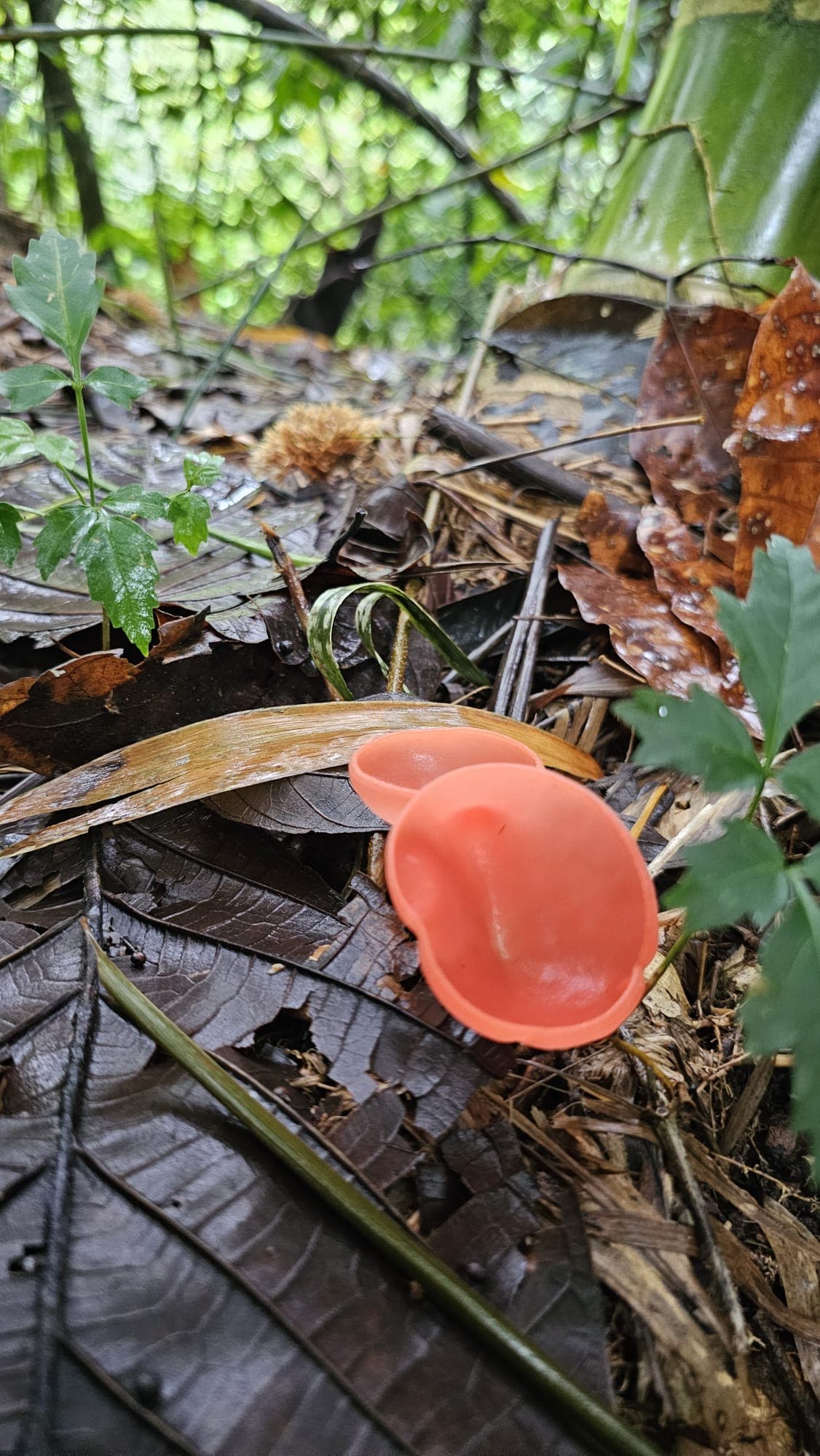
Some of the most visually dramatic fungi on Earth grow in Costa Rica. Vivid reds, oranges, and whites. Latticed cage fungi, phalloid stinkhorns, and net-skirted species emerge within hours of rain. I find them on the farm edge after heavy downpours.
Mycorrhizal forest networks
The forest floor is connected by fungal threads invisible to the eye — mycelium networks linking tree roots across hectares. This is what the old-growth forest at Corcovado and Braulio Carrillo protects. You don't see it, but you're walking on it.
Locally harvested edible species
Ticos in rural areas know which local fungi are edible and harvest them seasonally. My neighbors collect specific species from the farm forest after rain — knowledge that isn't written anywhere. A conversation with the right neighbor teaches more than any field guide.

Best locations for tropical mycology

Bioluminescent species, cordyceps, old-growth diversity
Year-round humidity keeps fungi fruiting constantly
Bracket fungi, stinkhorns, neighbor-identified edible species
Highest humidity — largest specimens, most dramatic growth
1 hour from San José — accessible mycology without a 3-day expedition
High-altitude species, different families from lowland forest
Ready to explore the fungal kingdom?
Whether you want to include mycology stops in a broader Costa Rica itinerary or focus a trip specifically on fungi and tropical forest diversity — I can build a route that puts you in the right place at the right time.