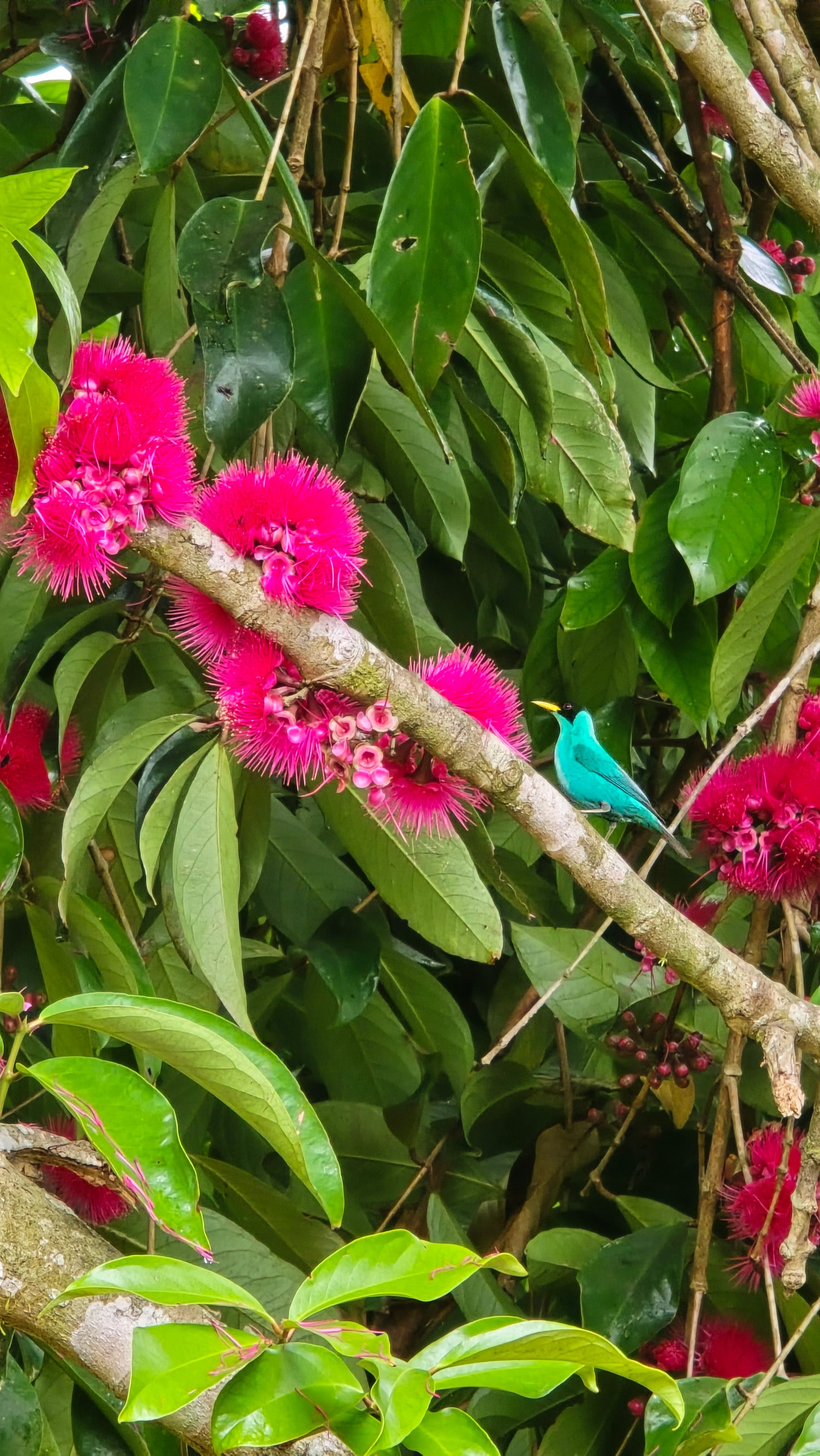
Costa Rica has 950+ bird species. I know where to find yours.
I live on a farm where hummingbirds greet me early morning, woodpeckers make holes in my oranges, and scarlet macaws announce they are flying above as loudly as they can. As a fellow bird lover, I plan tailored birdwatching itineraries across Costa Rica — species by species, region by region.
A 13-hectare bird paradise — with a guesthouse.
My farm is in one of the most authentically Costa Rican areas of the country — between San José and the Pacific, in the green hills of the Puriscal region. It's 13 hectares of fruit trees, coffee plantation, and forest — and it's full of birds.
Scarlet macaws fly over the farm every morning. Parrots nest in the mango trees. Toucans visit the papaya. Hummingbirds are constant. Woodpeckers work the old trees at the edge of the forest. It's not a zoo or a reserve — it's just what happens when you let 13 hectares live.

Species to look for — and where
From the farm to the far corners of Costa Rica
Early morning is everything
Costa Rica's birds are most active in the two hours after dawn. These itineraries are built around this — lodges positioned for sunrise walks, no wasted morning light on transfers. The birds you came for are almost always waiting before 8am.
From the farm in the Puriscal region, scarlet macaws fly over in formation at first light. You hear them before you see them — a wild, prehistoric sound that sets the tone for the whole day.

Best birdwatching spots — with independent travel logistics
These are the spots I send my clients to. For each one I know the best entry time, which local guides are worth hiring, and which spots guidebooks get wrong.
The Farm — Puriscal region
Scarlet macaws, parrots, toucans, hummingbirds · farm stay available
Monteverde Cloud Forest
Resplendent Quetzal, Three-wattled Bellbird, 400+ species
Carara National Park
Scarlet Macaw (year-round), 400+ species, riverside birds
Rancho Naturalista
500+ species recorded from the property alone
Corcovado National Park
Harpy Eagle (rare), forest raptors, endemic species
Have a target species?
Tell me what you're after — the Resplendent Quetzal, the Harpy Eagle, a specific hummingbird — and I'll tell you exactly where and when. That's the itinerary I build.
Common questions
When is the best time for birdwatching in Costa Rica?
December through April is the dry season and generally the best time. The Resplendent Quetzal is most visible February–May during nesting season. My farm in the Puriscal region has scarlet macaws, toucans, and parrots year-round.
How many bird species are in Costa Rica?
Over 930 recorded species — more than the entire continental United States and Canada combined. Around 600 are year-round residents.
Can I stay on your farm to birdwatch?
Yes. The farm has a guesthouse near the coffee plantation. Scarlet macaws fly over every morning and evening. Parrots, toucans, and hummingbirds are daily visitors. It's a genuine bird paradise — and a very authentic Costa Rican experience.
Do I need a guide for every spot?
Not for every spot. Monteverde, Carara, and my farm is easy to enjoy without a guide. For Rancho Naturalista and Corcovado, a local specialist guide dramatically increases rare sightings.
Is Costa Rica good for birders coming from Japan or Korea?
Absolutely. Costa Rica is consistently ranked among the world's best birdwatching destinations. Costa Planner works with English-speaking travelers from Asia and can build a complete trip tailored to your target species list.
What gear do I need?
8x42 binoculars are the standard. A field guide (Garrigues & Dean) helps enormously. Early mornings and patience are the real keys — my farm is perfect for a 5:30am start.
Ready to plan your birdwatching trip?
Stay at the farm, get a custom itinerary, or both. I work with birders from Europe, Asia, and the Americas — in English, French, or Polish.
Pura vida. The birds will be worth it.